
Düsseldorf
Bonner Str. 367-371
40589 Düsseldorf
Phone:+49 211 515 81 70
Fax:+49 211 515 81 728
Email: info@trade-world-one.de
Vienna
Rathausstrasse 21/12
1010 Vienna
Phone: +43 664 171 89 69
Email: kontakt@trade-world-one.at

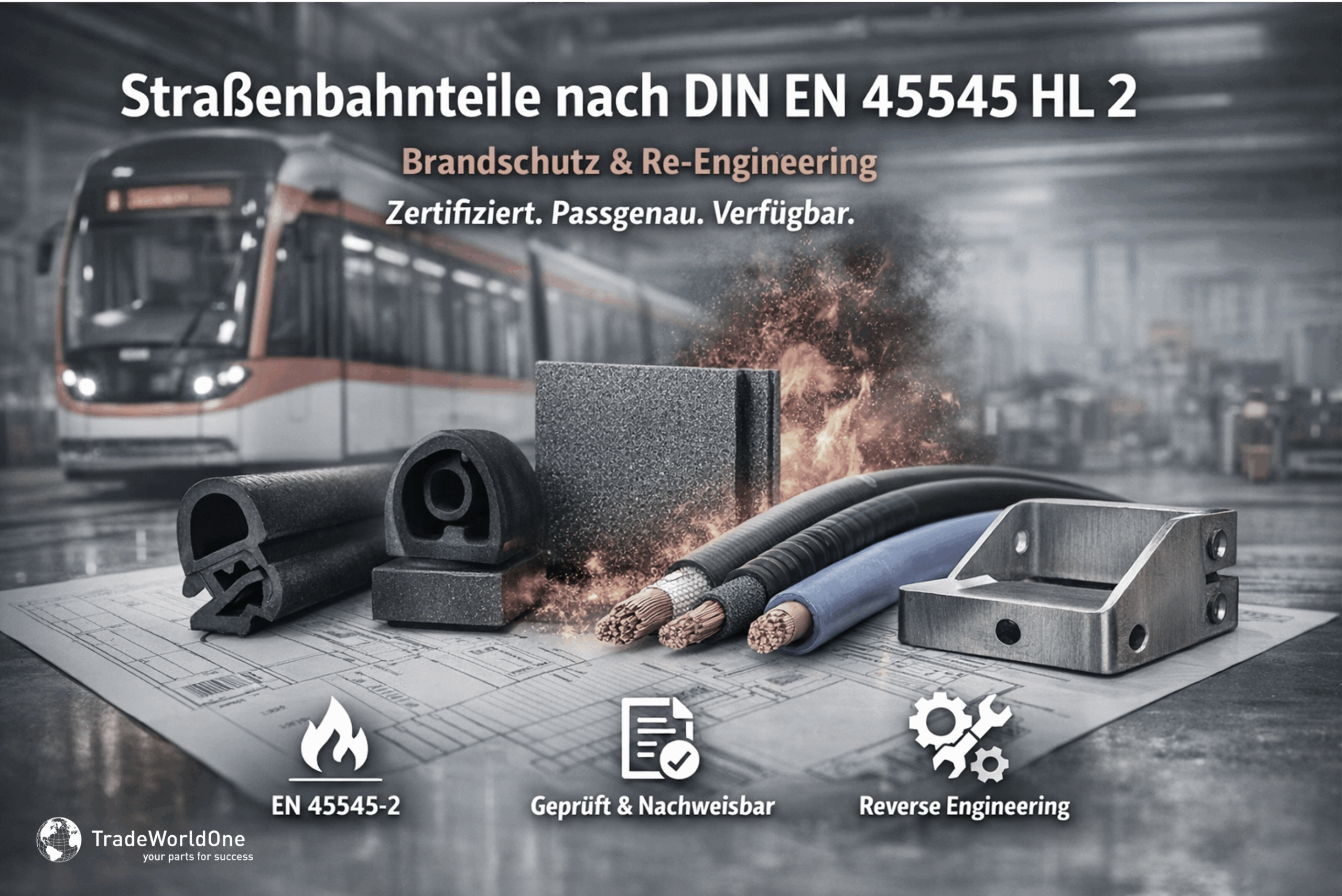
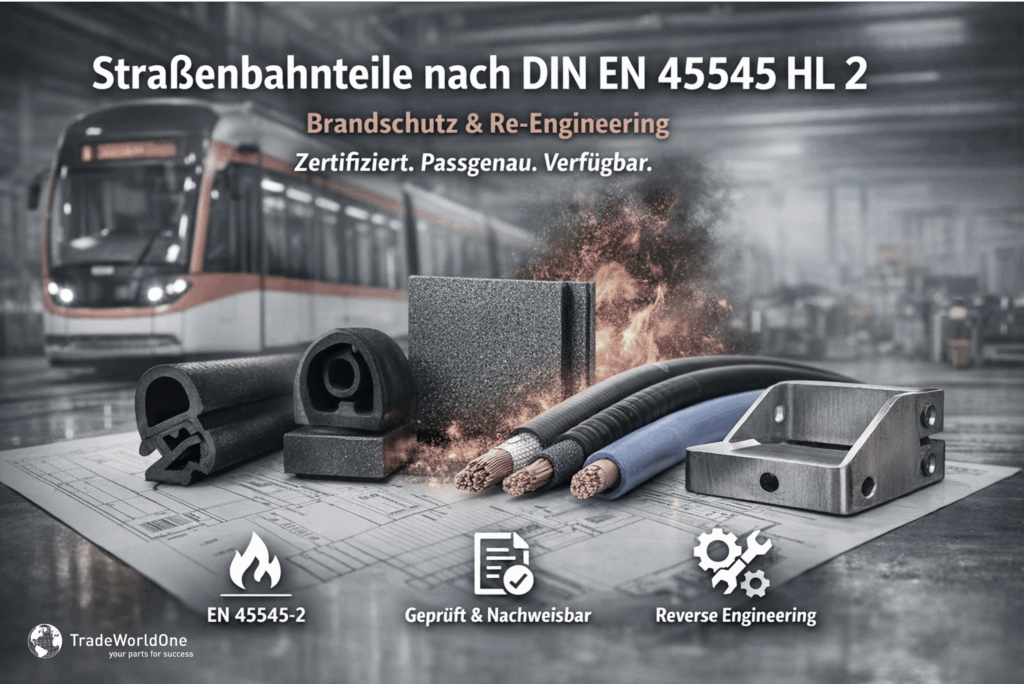
Tram Components Compliant with DIN EN 45545 HL 2: The Solution for Fire Protection and Materials Engineering
In the world of rail vehicle engineering, the focus has shifted noticeably: today, a component’s suitability for use is determined not only by its mechanical strength, but also by its material composition, testing strategy and verification documentation. A key reference framework in this context is the DIN EN 45545-2 series of standards. At Trade World One, we do not see these requirements as an obstacle, but as an integral part of modern engineering.
Do you have any questions? Feel free to contact us at any time.
» To the contact pageFor tram and light rail operators, Hazard Level 2 (HL 2) is the most common target requirement across many applications and component groups – depending on the operating profile and installation location. This article examines the interaction between material procurement, technical feasibility and standards-compliant documentation – from the perspective of a partner who is equally at home on the workshop floor and in technical specifications.
The Evolution of Standards and Their Impact on Procurement
The transition from national standards such as DIN 5510-2 to the harmonized European standard DIN EN 45545-2 marked a turning point for many transport operators. For maintenance departments, this meant that proven components had to be reassessed – not only in terms of geometry, but also with regard to materials and verification requirements.
Depending on the operating scenario, trams and light rail vehicles are frequently assigned to operating categories from which requirements up to HL 2 may arise for relevant components. For technical procurement, this means that simply “copying and pasting” legacy parts is rarely a robust solution. This is precisely where our expertise in light rail components compliant with EN 45545-2 comes into play: we analyze not only the geometry, but the complete materials engineering design, including the applicable testing and verification status.
The challenge is to identify materials that meet limit values for factors including flame spread, heat release rate (MARHE), smoke development and toxicity – without compromising functional properties such as elasticity, fatigue resistance and resistance to fluids and chemicals.
The Trade-Off: Mechanical Performance vs. Fire Protection in HL 2-Compliant Tram Components
A key issue in procurement is the trade-off between flame retardancy and mechanical performance. This is particularly relevant to elastomers and plastics used in seals, mountings, covers and insulation components.
To meet requirements up to HL 2, polymers are frequently formulated with flame-retardant systems such as ATH/MDH. Halogen-containing systems are no longer desired or permitted in many projects. Mineral fillers are well established, but often have to be used at high loading levels – with a noticeable impact on mechanical properties such as hardness, elongation at break, resilience and fatigue resistance.
As a technical procurement partner, our role is to source or develop precisely those compounds and component concepts that combine both worlds: compliance with EN 45545-2, targeted to the relevant product group, together with reliable in-service performance – rather than relying on standard compounds that put service life and functionality at risk.
Specific Material Requirements and Requirement Sets R1, R10 and R22
DIN EN 45545-2 structures its requirements through Requirement Sets (R sets) and product groups, depending on component type, installation location and application. In practice, this means that the correct verification results from the combination of component design, material system and appropriate testing.
Interior Materials (R1)
For large-surface components such as panels, covers and interior modules, heat release – including MARHE – is often a decisive factor. With composite materials such as GFRP/CFRP, the choice of resin system and process stability are critical. Trade World One relies on supply chains that ensure reproducible quality and robust verification documentation.
Seats and Upholstery (R6)
Here, combining vandal-resistant design, comfort and low flammability is particularly challenging. We preferably source textiles, foams and construction variants as tested system combinations, because the standard often evaluates the complete assembly – material + construction + fabrication – rather than individual materials alone.
Seals and Elastomers (R22/R23)
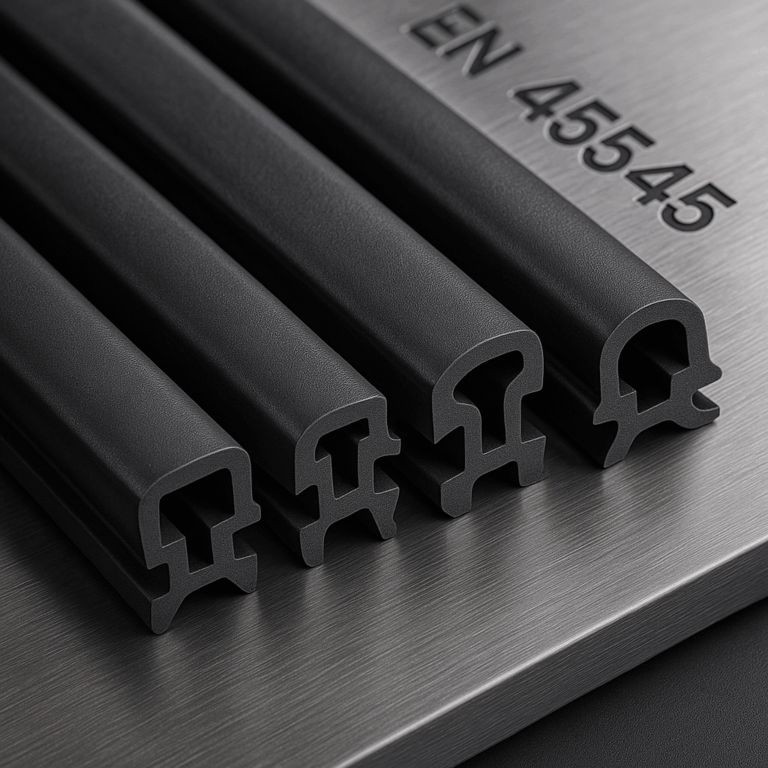
For seals, smoke development and smoke gas characteristics are often limiting factors. EPDM compounds that were previously standard frequently have to be reformulated or specifically selected to meet EN 45545-2 requirements. When reproducing obsolete window or door seals in particular, the challenge is to extrude historic profile geometries on a 1:1 basis while using a modern material system with verifiable standards compliance. This is exactly our philosophy: not off-the-shelf products, but precisely tailored solutions.
Floor Coverings (R10)
Floor systems are frequently subject to Requirement Set R10. In addition to fire protection requirements, slip resistance, abrasion resistance, resistance to cleaning chemicals and long-term performance are critical. We focus on robust multilayer systems that combine a durable wear layer with a fire-optimized supporting structure – including clearly defined interfaces such as adhesives, substrates and joints.
Obsolescence Management for Rail Components & Reverse Engineering
One of the greatest challenges is maintaining vehicles that were developed before EN 45545-2 was introduced. When components need to be replaced, original parts are often no longer available – or the existing verification documentation no longer meets current requirements.
This is where our Reverse Engineering and Material Re-Engineering approach comes into play:
a transport operator sends us a defective component. We digitize its geometry, analyze the existing material system and define a targeted substitution. We replace the original material with a modern equivalent capable of meeting the relevant EN 45545-2 requirements for the respective product group.
The result is a component that matches the original geometry on a 1:1 basis (“Form, Fit”) while being functionally upgraded to the current state of the art (“Function”) – including the required evidence, test reports and documentation for a clean and traceable project approval.
Documentation as a Safety Anchor: Fire Protection Verification for Rail Vehicles
A material without robust documentation is practically worthless. What matters is traceability, clear specifications, defined test criteria and a consistent documentation chain – from the material batch through to the installed component.
Trade World One places the highest priority on complete traceability and transparent verification. Where required, we work with test reports in accordance with EN 45545-2 and supplementary documentation such as declarations of conformity, batch identification and change control. This creates the level of reliability required to withstand audits, acceptance procedures and technical approvals – regardless of whether the context involves tramway supervisory authorities such as TAB or railway-related authorities such as EBA in mixed-operation environments.
Logistics and Availability of HL 2 Fire Protection Components for Trams
The availability of specialized, standards-compliant materials is volatile across many product categories. Our warehouse in Germany acts as a buffer and enables short response times. For framework agreement partners, we hold critical spare parts – from seals to selected components – in stock according to demand.
We ensure appropriate storage conditions in accordance with DIN 7716 so that elastomers and other sensitive materials reach the customer “fresh” and fully functional – including clear identification, FIFO logic and traceable batch management.
Specialist Areas: Cables, Adhesives and Sustainability
- Cables and Wiring (R15/R16): We source cable systems that meet fire protection requirements while remaining sufficiently flexible for confined cable ducts and dynamic installation conditions. Wir beschaffen Kabelsysteme, die brandschutztechnische Anforderungen erfüllen und zugleich ausreichend flexibel für enge Kabelkanäle und dynamische Einbausituationen bleiben.
- Adhesives and Sealants: In cooperation with chemical industry partners, we provide systems that are suitable for the respective assembly and can be verified as standards-compliant – without compromising adhesion or processability. Adhesives and Sealants: In cooperation with chemical industry partners, we provide systems that are suitable for the respective assembly and can be verified as standards-compliant – without compromising adhesion or processability.
- Sustainability: Sustainability: We monitor trends such as “Green Fire Safety” – including bio-based systems, recycled content and halogen-free concepts – and assess their potential in the context of EN 45545-2 in order to prepare customers for future requirements at an early stage.
Practical Example: Manufacturing Tram Components in Accordance with EN 45545
Consider glass mountings for partition walls: on older models, the original tooling is often no longer available. We take samples, analyze the geometry and material, and redesign the tooling. The decisive step is material selection – for example, an EPDM compound for which robust evidence of compliance with EN 45545-2 can be provided for the relevant product group.
Following production of the first samples (FAI/first article) and the agreed fire testing, series production is approved. The customer receives a replacement part that fits precisely, is supported by documented evidence and meets the requirements of modern maintenance practice. This is exactly where the added value of our manufacturing of tram components in accordance with EN 45545-2 lies.
Summary: Your Partner for Compliance and Availability
Compliance with DIN EN 45545-2 – or conformity where contractually required, frequently up to HL 2 – is non-negotiable in many projects and places high demands on materials expertise, testing strategy and documentation. Standard trading and off-the-shelf procurement quickly reach their limits in this environment.
Trade World One bridges the gap between complex standards and the practical realities of the workshop. We deliver not just parts, but verifiable compliance, safety and security of supply – from procurement through to the re-engineering of obsolete components. Fast, reliable and precisely to specification.
In a world where requirements are constantly changing, you need stability. Together, let us ensure that your fleet does more than simply keep moving – it remains safe and fit for the future. With Trade World One, fire protection becomes a genuine mark of quality in your maintenance operations.
Transparency Note: The content above was created with AI assistance and has been carefully reviewed by our team. We are committed to ensuring the highest quality. If you have any comments, we welcome your feedback via our contact form.
Sources
- Wikipedia: EN 45545-2 – Europäische Norm für Brandschutz in Schienenfahrzeugen
- DKE: DIN EN 45545-2:2016-02 – Anforderungen an das Brandverhalten von Materialien und Komponenten
- MPA Dresden: Brandschutzanforderungen für Bahnkomponenten nach EN 45545
- ZVEI: Leitfaden zur Anwendung der EN 45545 für Elektroisolierstoffe in Schienenfahrzeugen
- Assured Systems: Erklärung der EN 45545-2 Anforderungen für Schienenkomponenten
- PowerRubber: Überblick über Norm EN 45545 und Gefahrenstufen HL1 bis HL3
- J-Flex: Was ist EN 45545-2 und ihre Anwendung auf Materialien in Schienenfahrzeugen
- Wikipedia: DIN EN 45545 – Brandschutzstandards für Bahnanwendungen
- Beuth Verlag: DIN EN 45545-2 Normendetails zu Brandverhalten von Komponenten
- VDE Verlag: Technische Spezifikationen der DIN EN 45545-2 für HL2-Komponenten
Do you have any questions? Feel free to contact us at any time.
» To the contact page

 English
  Deutsch
  Español
  Français
  Italiano
  Nederlands
  Svenska
  Dansk
Dansk  Suomi
Suomi  Norsk bokmål
  Português