
Düsseldorf
Bonner Str. 367-371
40589 Düsseldorf
Phone:+49 211 515 81 70
Fax:+49 211 515 81 728
Email: info@trade-world-one.de
Vienna
Rathausstrasse 21/12
1010 Vienna
Phone: +43 664 171 89 69
Email: kontakt@trade-world-one.at



Ballistic Glazing for Special Protection Vehicles: EN 1063, VPAM, BR and VR Classes
Ballistic glazing for special protection vehicles is bullet-resistant glazing that must be matched to the required protection level, the vehicle and the specific installation situation. This article explains the classes defined by DIN EN 1063 and VPAM-BRV, puts the commonly used designations B4, B6 and B7 into context, and explains the key considerations regarding spall protection, system integration, retrofit applications and the procurement of ballistic glazing.
Do you have any questions? Feel free to contact us at any time.
» To the contact pageThis does not refer to screen protectors for smartphones. In technical terms, we are talking about ballistic or bullet-resistant glazing – also referred to as bullet-resistant glass, ballistic glass or transparent armor. Such glazing is used in special protection vehicles, armored vehicles and other security- and defense-related applications.
Contents
- How Ballistic Glazing Works
- EN 1063 or VPAM: Which standard applies to what?
- BR1 to BR7 according to DIN EN 1063
- VR1 to VR10 according to VPAM-BRV
- Correctly Classifying B4, B6 and B7
- Other Relevant Standards and Regulations
- How Ballistic Glass Is Tested
- Spall protection in ballistic glazing
- Thickness and weight
- Glass, frame and seal as a system
- Reproduction without drawings
- What ballistic glazing costs
- Information Required for an Inquiry
- Frequently asked questions
How Ballistic Glazing Works
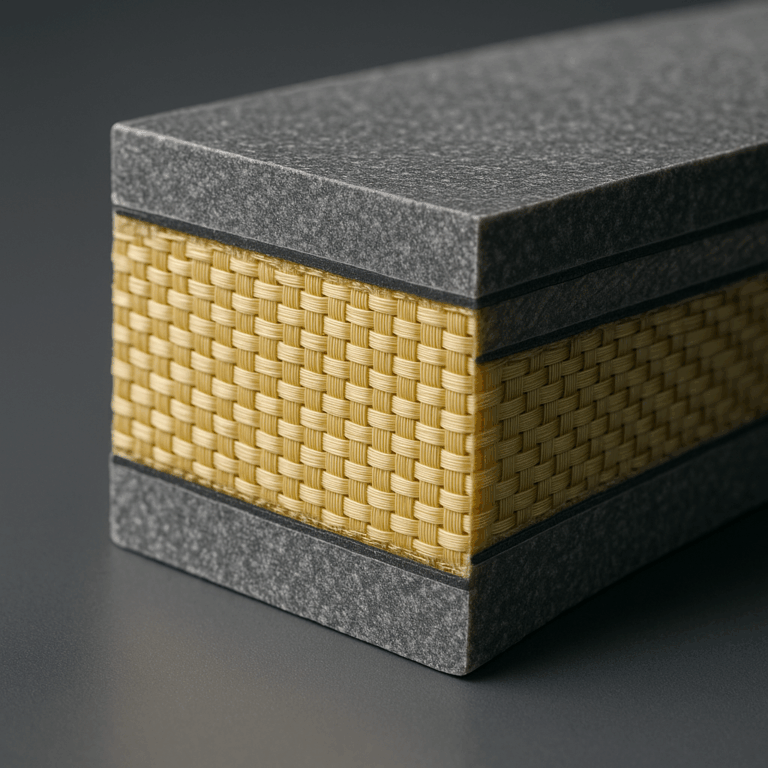
Ballistic glass is not simply an exceptionally thick single pane, but a composite material. Its protective effect is created by a defined multilayer structure designed to absorb and distribute the energy of an impacting projectile.
The outer, harder layers are intended to deform the projectile and absorb energy at an early stage. Subsequent glass and polymer layers distribute the load and retain fragments within the laminate.
Depending on the design, float glass, chemically strengthened glass or borosilicate glass may be used. Intermediate layers can include polyvinyl butyral (PVB), thermoplastic polyurethane (TPU) or ionoplasts. Where specific rear-face spall protection is required, an additional internal polycarbonate layer may also be incorporated.
The mechanical coupling between the layers is critical. Temperature fluctuations, moisture, unsuitable storage conditions or defects in lamination and edge sealing can lead to delamination. This may impair optical quality and service life and, in cases of pronounced damage, also becomes relevant when technically assessing the protective performance.
EN 1063 or VPAM: Which standard applies to what?
“Bulletproof glass” is not a sufficient technical specification. A requirement only becomes technically robust when the applicable test standard, resistance or protection class, defined test ammunition and specific installation situation are clearly specified together.
DIN EN 1063 covers the testing and classification of bullet resistance for security glazing. At the time of the technical review of this article in September 2026, DIN Media continued to list DIN EN 1063:2000-01 as the current German edition.
VPAM-BRV, by contrast, is a testing guideline for special-protection vehicles. VPAM currently lists Version 3, dated March 15, 2021. It is applied together with VPAM-APR Version 3, also dated March 15, 2021. VPAM-APR defines the general principles for ballistic testing of materials, constructions and products, while VPAM-BRV specifies these requirements for special-protection vehicles.
Find out more about our capabilities under Defense Technology & Military Technology at Trade World One..
BR Is Not the Same as VR
This distinction is crucial for technical procurement:
BR classes according to EN 1063 describe the tested bullet resistance of a glazing system. VR classes according to VPAM-BRV describe a special-protection vehicle as a complete system.
A BR6-class glazing system therefore does not automatically make a vehicle a VR6-class vehicle.
In a special-protection vehicle, the glass is only one part of the protective system. Doors, pillars, body structure, sills, joints, overlaps, frames and the transitions between transparent and opaque protection zones are also relevant. VPAM-BRV therefore requires testing of the structural areas that determine the vehicle’s overall protective performance.
A pane classified according to EN 1063 is therefore a qualified component – it is not yet a classification of the complete vehicle.
With VPAM, the Guideline Version Is Not the Only Factor
When applying VPAM guidelines, the printed version alone should not be considered. VPAM-BRV explicitly identifies VPAM resolutions as co-applicable documents, and VPAM-APR also refers to further resolutions and supplementary documents.
For technical assessment, the relevant basis is therefore the currently applicable combination of guideline, revision status and applicable VPAM resolutions.
Find out more about our capabilities under Defense Technology & Military Technology at Trade World One..
BR1 to BR7 according to DIN EN 1063
DIN EN 1063 divides bullet-resistant glazing into different resistance classes. The BR classes range from a defined small-caliber threat through to rifle ammunition with a hard core.
| Class | Test threat | Classification |
|---|---|---|
| BR1 | .22 Long Rifle | Small-caliber threat |
| BR2 | 9 × 19 mm | Handgun threat |
| BR3 | .357 Magnum | Increased handgun threat |
| BR4 | .44 Remington Magnum | High handgun threat |
| BR5 | 5,56 × 45 mm | Rifle threat |
| BR6 | 7.62 × 51 mm, soft core | Increased rifle threat |
| BR7 | 7.62 × 51 mm, hard core | Hard-core threat |
EN 1063 also defines the SG1 and SG2 classes for specified shotgun threats. They are not a continuation of the BR scale because they are based on different test ammunition.
The table is intended for general orientation. For tendering, procurement and testing, the complete parameters specified by the standard are decisive. These include projectile design, projectile mass, impact velocity, firing distance and shot pattern.
The resistance-class designation is also supplemented by an assessment of rear-face spall. The designations S and NS are explained later in the section on spall protection.
VR1 to VR10 according to VPAM-BRV
VPAM-BRV is a key testing guideline for special-protection vehicles. Vehicle classes VR1 to VR10 are linked to the corresponding test levels of VPAM-APR.
| Vehicle class | Test level | Test threat – simplified |
|---|---|---|
| VR1 | 1 | .22 Long Rifle |
| VR2 | 2 | 9 mm Luger |
| VR3 | 3 | 9 mm Luger, higher test velocity |
| VR4 | 4 | .357 Magnum und .44 Remington Magnum |
| VR5 | 5 | Defined .357 Magnum test threat |
| VR6 | 6 | 7.62 × 39 mm, iron core |
| VR7 | 7 | 5.56 × 45 mm and 7.62 × 51 mm |
| VR8 | 8 | 7.62 × 39 mm, hard core |
| VR9 | 9 | 7.62 × 51 mm, hard core |
| VR10 | 10 | 7.62 × 54 R, hard core |
The complete test conditions are defined in VPAM-APR. Some test levels take multiple threats into account.
The key point remains:
The VR class does not assess the ballistic glass alone; it assesses the protective performance of the special-protection vehicle as a whole.
Correctly Classifying B4, B6 and B7
Designations such as B4, B4+, B6 or B7 are still commonly encountered for special-protection vehicles, in older quotation documents and on the used-vehicle market.
One point is particularly important:
These B designations are not vehicle resistance classes defined by a standard.
Rudolf Frieß, then head of the Ulm Proof House, explicitly states in his technical article “Testing of Ballistic Material for Special-Protection Vehicles” that the widely used designations B4, B4+, B6 and B7 as resistance classes are not based on any standard or guideline.
This is relevant to procurement because B designations are often used in the market as though they could be directly converted into today’s BR or VR classes.
Such a 1:1 conversion is not technically reliable.
Test methods, test ammunition, projectile velocity, shot pattern, angle of attack, tested vehicle areas and other test conditions may differ.
For a reliable assessment of a specific special-protection vehicle, the underlying test report, the test guideline actually applied, the test ammunition and the tested vehicle configuration are therefore always decisive.
In short: B4, B6 and B7 may be used in the market as shorthand for an assumed threat level, but they are no substitute for a clearly documented BR or VR classification.
Other Relevant Standards and Regulations
Depending on the application, vehicle and target market, standards and test systems other than DIN EN 1063 and VPAM may also be relevant.
| Standard / system | Typical area of application |
|---|---|
| EN 1522 / EN 1523 | Bullet resistance of windows, doors, shutters and comparable constructions |
| STANAG 4569 | Protection requirements for military or armored vehicles |
| NIJ | U.S. testing and classification approaches |
| UL 752 | U.S. classification of bullet-resistant components |
These systems should not be treated as equivalent using simplified conversion tables.
Different standards and test systems may specify different test ammunition, velocities, shot patterns, angles of attack and assessment methods.
An international inquiry should therefore first be reduced to a clearly defined threat and test profile.
Is DIN EN 1063 Being Revised?
In 2019, a revision draft was published as prEN 1063:2019 and DIN EN 1063:2019-10.
Compared with DIN EN 1063:2000-01, the draft included, among other changes, new test ammunition for BR3, an additional rifle class KS and more clearly defined extension rules.
Important for current tenders:
The 2019 draft has not yet replaced DIN EN 1063:2000-01. In September 2026, DIN Media continued to list DIN EN 1063:2000-01 as the current standard.
How Ballistic Glass Is Tested
A ballistic test is not an unrestricted practical test. The applicable standard or guideline defines, among other things:
- Test ammunition and projectile type
- Projectile mass
- Impact velocity
- Firing distance
- Impact points
- Spacing between impacts
- Number of impacts
- Assessment of penetration
- Assessment of rear-face spall
Three Shots in a Defined Triangle According to EN 1063
For the BR classes under EN 1063, three test specimens are tested. Each specimen receives three controlled shots arranged in an equilateral triangle with a side length of 120 mm.
This defined test arrangement is important: a resistance class is not based on a pane having “somehow survived three shots.” Ammunition, velocity, distance, shot location and other test conditions are specified.
Angle of Attack in Vehicle Testing
With a special-protection vehicle, an additional level of assessment is involved.
VPAM-BRV defines the angle of attack by the inclination of the weapon from 0° to 90° and by the vehicle’s position relative to the line of fire from 0° to 360°.
This illustrates why not only large surface areas, but also transitions, joints and structurally critical areas are decisive for protective performance.
What Does Multi-Hit Mean?
Multi-Hit describes the loading of a protection system by several impacts occurring close to one another.
The first impact has already altered the material and laminate locally. Subsequent impacts therefore act on an area that has already been damaged.
VPAM-BRV defines both the standard triangular shot pattern and the Multi-Hit test using three impacts whose shot pattern forms an equilateral triangle.
In ballistic glass, the layer structure, pane geometry, distance from the edge, frame stiffness and installation conditions also influence behavior under multiple impacts.
What Role Do Proof Houses and Test Laboratories Play?
Ballistic protection systems are tested by appropriately qualified test laboratories.
Depending on the applicable standard and test scope, these may include state proof houses as well as other accredited or recognized institutes.
For technical procurement, this means:
Claims such as “bullet-resistant” or “bulletproof” should be supported by a traceable test report, a classification or another clearly defined form of evidence.
Trade World One is a technical procurement and solutions partner – not a proof house or an independent test laboratory.
Spall protection in ballistic glazing
A projectile does not have to fully penetrate a glazing system for a hazard to arise on the protected side.
On impact, fragments of glass or other material may detach from the rear face of the laminate. This rear-face fragmentation is commonly referred to as spall or rear-face fragment release.
This effect is particularly relevant in vehicles because occupants may be located directly behind the glazing.
DIN EN 1063 therefore distinguishes between:
NS – no corresponding spall: The specified spall indicator is not perforated accordingly during the test.
S – spall: Corresponding rear-face spall is detected during the test.
A complete classification may therefore be stated, for example, as BR6 NS rather than simply BR6.
Older documents and parts of industry practice also use the abbreviations SF for “spall-free” and SA for “spall.” DIN EN 1063 uses the designations S and NS.
Depending on the system design, internal polycarbonate layers may be used, for example, to reduce the risk of rear-face spall.
Thickness and weight
How Thick Is Ballistic Glass?
There is no universally applicable thickness in millimeters for a specific BR class.
DIN EN 1063 defines the required protective performance and test conditions, not a mandatory glass construction. Different material combinations can therefore achieve the same resistance class with significantly different thicknesses and areal weights.
Publicly documented manufacturer products illustrate this range:
A Hammerglass construction stated as BR6-NS is specified at 39 mm thickness and 90 kg/m². By contrast, sedak specifies 71 mm and 171 kg/m² for a construction likewise classified as BR6-NS.
For BR7-NS, SILATEC lists 60 mm and 130 kg/m² for a published construction, while sedak specifies 82 mm and 196 kg/m² for BR7-NS.
These values are neither normative requirements nor product specifications of Trade World One. They merely use publicly documented manufacturer examples to illustrate how differently technically tested constructions within the same resistance class may be designed.
In addition, glazing constructions developed for buildings or standard products cannot automatically be transferred to vehicle glazing.
The actual thickness depends, among other things, on:
- Required protective performance
- Underlying threat profile
- Glass types and number of glass layers
- Polymer interlayers
- Polycarbonate content
- Multi-Hit requirements
- Pane size and curvature
- Optical requirements
- Edge construction
- Installation situation
- Temperature and ageing requirements
For procurement, the decisive factor is therefore not a generic thickness value in millimeters, but the specific construction for which the required protective performance has been demonstrated.
Trade World One procures and supplies ballistic glazing on a project-specific basis in accordance with the customer’s technical requirements.
How Heavy Is Ballistic Glass?
Weight likewise cannot be derived generically from a BR or VR class.
In special-protection vehicles, areal weight becomes a key integration parameter.
A heavier pane can affect:
- Frame and window rebate
- Hinges
- Door kinematics
- Window regulators and lifting mechanisms
- Seals
- Center of gravity
- Permissible vehicle mass
- Axle loads
If the customer specifies a maximum areal weight or maximum pane thickness, this requirement can form part of the procurement specification and technical design.
For weight-sensitive special applications, alternative material concepts using transparent ceramics such as spinel or ALON may also be relevant.
Glass, frame and seal as a system
From a design perspective, ballistic glass does not end at its outer edge.
In a real threat scenario, a projectile will not necessarily strike only the center of the pane. Edge areas, joints and transitions between transparent and opaque armor are therefore essential elements of the overall system design.
Glass, frame, rebate, seal and fastening must be considered as one integrated system.
Unsuitable adhesives or elastomers can also affect the edge seal and, over time, promote delamination or other forms of material damage.
Where required, Trade World One therefore considers not only the glazing itself, but also suitable seals, mounting components and any necessary modifications in the context of the specific installation situation.
Optical Quality
Protective performance is not the only safety-relevant property of vehicle glazing.
The driver must be able to see reliably under varying lighting and weather conditions.
In complex and thick laminated glazing systems, the following factors may become relevant, among others:
- Inherent coloration
- Optical distortion
- Doppelbilder
- Reflexionen
- reduzierte Lichttransmission
Je nach Anforderung kann Low-Iron- beziehungsweise Weißglas eingesetzt werden, um die Eigenfärbung des Verbundes zu reduzieren und die Lichttransmission zu verbessern.
Heizung, Sensorik und EMV
Frontscheiben benötigen in vielen Anwendungen elektrische Heizungen.
Die erforderlichen Leitstrukturen müssen so in den Verbund integriert werden, dass sie den Herstellungsprozess und die thermischen sowie mechanischen Belastungen im späteren Betrieb dauerhaft überstehen.
Je nach Anwendung können darüber hinaus segmentierte Heizfelder, Sensorfunktionen oder EMV-relevante Funktionsschichten erforderlich sein.
Delamination
Delamination gehört zu den typischen Schadensbildern komplexer Verbundverglasungen.
Dabei lösen sich einzelne Schichten lokal voneinander. Einflussfaktoren können Feuchtigkeit, Temperaturwechsel, Materialunverträglichkeiten, Randbeschädigungen oder ungeeignete Lager- und Einsatzbedingungen sein.
Bei einer ballistischen Verglasung ist Delamination nicht ausschließlich eine optische Frage. Die definierte mechanische Kopplung der einzelnen Schichten ist Bestandteil des Verbundsystems.
Eine deutlich delaminierte Scheibe in einem Sonderschutzfahrzeug sollte deshalb fachlich bewertet werden.
Lagerung und Versorgungssicherheit
Ballistische Verglasung ist keine beliebige Lagerware.
Zwischenlagen, Randverbünde und Verklebungen können auf Feuchtigkeit, UV-Strahlung und ungeeignete Lagerbedingungen reagieren. Gleichzeitig können die Wiederbeschaffungszeiten spezieller Verglasungen erheblich sein.
Trade World One verfügt über rund 1.500 m² kontrolliertes Lagerumfeld mit definierten Prozessen zur Bestandsrotation und dokumentierter Überwachung.
Gerade bei obsoleten Fahrzeugplattformen kann die gezielte Bevorratung kritischer Ersatzverglasungen sinnvoll sein.
Reproduction without drawings
Viele Sonderschutz- und Spezialfahrzeuge bleiben länger im Einsatz als die ursprünglichen Ersatzteilprogramme ihrer Hersteller.
Dann entsteht ein typisches Beschaffungsproblem: Eine Front-, Seiten- oder Heckscheibe muss ersetzt werden, der ursprüngliche OEM liefert das Bauteil jedoch nicht mehr oder eine belastbare Zeichnung ist nicht vorhanden.
In solchen Fällen kann die vorhandene Scheibe als Referenzbauteil dienen.
Trade World One arbeitet dafür nach Bemusterung. Die Geometrie des Bauteils wird digital erfasst und kann mittels 3D-Scan in CAD rekonstruiert werden.
Ein typischer Projektablauf:
- Analyse des vorhandenen Bauteils und des Schadensbildes
- digitale Geometrieaufnahme beziehungsweise 3D-Scan des Referenzbauteils
- Rekonstruktion der Geometrie in CAD
- Prüfung von Schutzanforderung, Bauraum und zulässigem Gewicht
- Definition des geeigneten ballistischen Verglasungsaufbaus
- Fertigung eines Erstmusters beziehungsweise Prototyps
- erforderliche Prüf- und Dokumentationsschritte
- Serien- und Ersatzteilversorgung sowie bei Bedarf Bevorratung
Messstrategie, Projektlaufzeit und Prüfaufwand werden projektspezifisch festgelegt.
Kann beim Retrofit eine höhere Schutzklasse realisiert werden?
Eine höhere Schutzanforderung kann technisch geprüft werden. Sie darf jedoch nicht allein auf die Verglasung reduziert werden.
Eine leistungsfähigere Scheibe kann mehr Bauraum benötigen, ein höheres Gewicht besitzen oder andere Anforderungen an Rahmen, Überdeckungen, Dichtungen, Befestigungen und Türmechanik stellen.
Eine höher klassifizierte Verglasung führt deshalb nicht automatisch zu einer höheren VR-Klassifizierung des gesamten Fahrzeugs.
Dokumentation und Rückverfolgbarkeit
Bei sicherheitskritischen Komponenten endet die Beschaffung nicht mit der physischen Lieferung.
Materialnachweise, Prüfberichte, Erstmusterunterlagen, Rückverfolgbarkeit und eindeutig definierte Bauteilstände können für Betreiber und Integratoren genauso relevant sein wie die Verglasung selbst.
Trade World One unterstützt unter anderem mit Dokumentation nach EN 10204, Erstmusterprüfberichten und bauteilbezogener Rückverfolgbarkeit entlang der vereinbarten Qualitäts- und Lieferprozesse.
What ballistic glazing costs
Ein pauschaler Quadratmeterpreis ist bei Panzerglas für Sonderschutzfahrzeuge selten belastbar.
| Kostenfaktor | Warum er relevant ist |
|---|---|
| Schutzanforderung | Anspruchsvollere Bedrohungsprofile können Material-, Fertigungs- und Prüfaufwand erhöhen. |
| Scheibengeometrie | Gebogene und dreidimensional geformte Verglasungen sind aufwendiger als ebene Bauteile. |
| Stückzahl | Werkzeug-, Rüst- und Engineeringkosten verteilen sich bei Kleinserien auf weniger Teile. |
| Reverse engineering | Fehlen CAD-Daten oder Zeichnungen, entsteht zusätzlicher Aufwand für Aufnahme und Rekonstruktion. |
| Erstmuster und Prüfung | Prototypen-, Erstmuster- und gegebenenfalls Beschussprüfungen sind eigenständige Projektpositionen. |
| Funktionsintegration | Heizung, Sensorik, EMV oder besondere Beschichtungen erhöhen die Komplexität. |
| Optische Anforderungen | Low-Iron-Glas, definierte Transmissionswerte oder enge Verzerrungsgrenzen beeinflussen den Aufbau. |
| Dokumentation | Rückverfolgbarkeit, Zeugnisse und Erstmusterunterlagen verursachen zusätzlichen Aufwand. |
| Rahmen und Dichtungen | Bei Retrofit-Projekten können angrenzende Komponenten Bestandteil der Lösung werden. |
Bei einer Nachfertigung ohne vorhandene Zeichnung kann der einmalige Engineering-Aufwand einen relevanten Teil der ersten Lieferung ausmachen.
Information Required for an Inquiry
„Wir benötigen eine Panzerglasscheibe BR6“ reicht für eine technisch belastbare Anfrage noch nicht aus.
| Benötigte Information | Beispiele |
|---|---|
| Norm / Prüfrichtlinie | DIN EN 1063, VPAM-BRV oder projektspezifische Vorgabe |
| Schutzanforderung | BR-Klasse der Verglasung beziehungsweise Schutzanforderung des Fahrzeugs |
| Splitteranforderung | beispielsweise S / NS nach EN 1063 |
| Geometrie | Länge, Breite, vorhandene Dicke, Krümmung, Kontur |
| Installation situation | Rahmen, Falz, Randbreite, Überdeckungen, Dichtungen |
| Bauraum | maximal zulässige Dicke |
| Gewicht | maximal zulässiges Scheiben- oder Flächengewicht |
| Optische Anforderungen | Transmission, Verzerrung, Low-Iron-Anforderung |
| Zusatzfunktionen | Heizung, segmentierte Heizfelder, Sensorik, EMV |
| Ausgangsdaten | Zeichnung, CAD-Daten oder vorhandenes Muster |
| Dokumentation | vorhandene Prüfberichte, Zeugnisse, Erstmusterunterlagen |
| Bedarf | Stückzahl, Wiederholbedarf, gewünschte Bevorratung |
Bei Retrofit-Projekten kommt eine zusätzliche Frage hinzu:
Soll lediglich ein vorhandenes Bauteil ersetzt werden oder soll das Schutzsystem konstruktiv verändert beziehungsweise neu ausgelegt werden?
Trade World One als technischer Beschaffungspartner
Trade World One unterstützt technische Einkäufer, Betreiber und Integratoren bei der Beschaffung und Versorgung mit Panzerglas, durchschusshemmendem Glas und ballistischer Verglasung für sicherheitskritische Anwendungen und Sonderschutzfahrzeuge.
Der Schwerpunkt liegt insbesondere dort, wo klassische Katalogbeschaffung nicht ausreicht: bei individuellen Geometrien, Bestandsplattformen, obsoleten Bauteilen und Projekten ohne vollständige OEM-Dokumentation.
Je nach Projekt umfasst der Ansatz:
- technische Spezifikation und Beschaffung ballistischer Verglasung
- Fertigung nach Bemusterung
- Reverse Engineering und 3D-Scan
- CAD-Rekonstruktion
- Abstimmung von Glas, Rahmen und Dichtung
- Erstmuster- und Prototypenprozesse
- Dokumentation und Rückverfolgbarkeit
- Ersatzteilversorgung
- Bevorratung kritischer Komponenten
Die Industrie-DNA dahinter stammt aus dem technischen Beschaffungsumfeld: Geschäftsführer Rainer Schieck bringt langjährige Erfahrung aus dem Einkauf bei Siemens und aus komplexen Großprojekten des Schienenverkehrs in den heutigen Beschaffungsansatz ein.
Das Ziel ist nicht, lediglich eine Scheibe aus einem Katalog auszuwählen, sondern eine technisch belastbare Lösung in ein reales System zu integrieren.
Frequently asked questions
Entspricht B6 der Klasse VR7?
Nein, nicht normativ. B6 ist eine im Markt weiterhin verwendete Bezeichnung, die als Fahrzeug-Widerstandsklasse auf keiner Norm oder Richtlinie basiert. Eine Einstufung als VR7 setzt eine entsprechende Prüfung und Klassifizierung des Fahrzeugs nach VPAM-BRV voraus.
Was bedeutet B7?
Auch B7 ist keine aktuelle normative VPAM-Fahrzeugklasse. Für eine belastbare technische Aussage müssen die tatsächlich angewandte Prüfrichtlinie, Prüfmunition, Prüfbedingungen und Fahrzeugdokumentation betrachtet werden.
Wie dick ist Panzerglas für BR6?
DIN EN 1063 schreibt keine allgemein gültige Dicke für BR6 vor. Öffentlich dokumentierte BR6-NS-Produkte zeigen beispielsweise sehr unterschiedliche Aufbauten. Diese Werte sind Produktbeispiele, keine Normwerte.
Was bedeuten S und NS?
S und NS beschreiben bei EN 1063 den rückseitigen Splitterabgang. In älteren Unterlagen finden sich dafür auch SF beziehungsweise SA.
What Does Multi-Hit Mean?
Multi-Hit beschreibt die Belastung eines Schutzsystems durch mehrere räumlich nahe Treffer.
Kann Panzerglas für alte Sonderschutzfahrzeuge nachgefertigt werden?
Ja, wenn Geometrie, Schutzanforderung und Einbausituation ausreichend erfasst werden können. Eine vorhandene Scheibe kann als Referenzbauteil dienen, digital vermessen und mittels 3D-Scan beziehungsweise CAD rekonstruiert werden.
Was tun, wenn keine Zeichnung der Panzerglasscheibe mehr vorhanden ist?
Eine vorhandene Scheibe kann als Muster aufgenommen werden. Anschließend werden Geometrie und Anschlussmaße digital rekonstruiert.
Kann beim Retrofit eine höhere Schutzklasse realisiert werden?
Eine höhere Schutzanforderung kann technisch geprüft werden. Die Entscheidung darf jedoch nicht an der Scheibe allein getroffen werden.
Ist eine delaminierte Panzerglasscheibe noch verwendbar?
Das lässt sich nicht allein anhand der optischen Erscheinung beantworten. Eine ausgeprägte Delamination sollte technisch bewertet werden.
Welche Rolle spielen Rahmen und Dichtungen?
Eine wesentliche. Die Verglasung muss konstruktiv mit Rahmen, Falz, Dichtung, Befestigung und angrenzender Panzerung zusammenwirken.
Fazit: Panzerglas ist keine Katalogware
Panzerglas für Sonderschutzfahrzeuge lässt sich nicht allein über einen Produktnamen, einen Millimeterwert oder eine Schutzklasse definieren.
Entscheidend sind Prüfregelwerk, Bedrohungsprofil, Splitterschutz, Verglasungsaufbau, Fahrzeugkonstruktion und Einbausituation.
DIN EN 1063 beschreibt die Durchschusshemmung einer Verglasung. VPAM-BRV betrachtet dagegen das sondergeschützte Fahrzeug als System. Die weiterhin verwendeten Begriffe B4, B6 und B7 sind keine normativen Ersatzbezeichnungen für diese heutigen Klassifizierungen.
Besonders anspruchsvoll wird die Versorgung, wenn ein Fahrzeug seit vielen Jahren im Einsatz ist, OEM-Quellen fehlen oder keine Zeichnungen mehr verfügbar sind. Dann werden Reverse Engineering, Werkstoff- und Systemverständnis, Dokumentation und Versorgungssicherheit genauso wichtig wie die Schutzanforderung selbst.
Trade World One verbindet diese Anforderungen mit technischer Beschaffungskompetenz – von der Spezifikation ballistischer Verglasung über Fertigung nach Bemusterung und geometrische Rekonstruktion bis zur Ersatzteilversorgung für bestehende Sonderschutz- und Spezialfahrzeuge.
Sprechen Sie mit uns
Sie benötigen Panzerglas beziehungsweise ballistische Verglasung für ein Sonderschutzfahrzeug, suchen Ersatz für eine obsolete Scheibe oder verfügen nicht mehr über die ursprüngliche Zeichnung?
Senden Sie uns die vorhandene Schutzanforderung, Angaben zum Fahrzeug und zur Einbausituation sowie – wenn verfügbar – Zeichnungen, Fotos oder Maße der Originalscheibe.
Gemeinsam klären wir, welche technische und beschaffungsseitige Lösung für Ihre Anwendung geeignet ist.
Anfrage zu Panzerglas und ballistischer Verglasung stellen
Transparency Note: The content above was created with AI assistance and has been carefully reviewed by our team. We are committed to ensuring the highest quality. If you have any comments, we welcome your feedback via our contact form.
Sources
- Deutsche Unis forschen für US-Militär an Panzerglas
- Rüstungsforschung: Fraunhofer untersucht Stabilität von Panzerglas
- US-Militär lässt in Deutschland forschen: Sprengstoff, Panzerglas und Munition
- Forschung zu Panzerglas durch Fraunhofer-Forscher
- Politik hinter Panzerglas in der Rüstung
- Wissenschaftliche Studie zur Geschosswirksamkeit und Panzerung
- Bundestagsdokumentation zu Rüstung und Panzermaterialien
- Rüstungsexportbericht mit Bezug zu Panzertechnologien
- Anwendungsstatus metallischer Werkstoffe für militärische Panzerungen
- Allgemeine Enzyklopädie zu Panzerglas in der Rüstung
- DIN EN 1063:2000-01 – Glas im Bauwesen – Sicherheitssonderverglasung – Prüfverfahren und Klasseneinteilung für den Widerstand gegen Beschuss.
- DIN EN 1063:2019-10 – Entwurf / prEN 1063:2019 – Überarbeitungsentwurf.
- VPAM-APR, Fassung 3, Stand 15.03.2021 – Allgemeine Prüfgrundlagen für ballistische Material-, Konstruktions- und Produktprüfungen.
- VPAM-BRV, Fassung 3, Stand 15.03.2021 – Sondergeschützte Fahrzeuge – Anforderungen, Klassifizierungen und Prüfverfahren.
- Rudolf Frieß: „Prüfung von ballistischem Material für Sonderschutzfahrzeuge“, 2006. Fachbeitrag des damaligen Leiters des Beschussamtes Ulm.
- Vetrotech / Saint-Gobain – Beschreibung des EN-1063-Prüfaufbaus.
- Hammerglass – öffentlich dokumentierte Produktbeispiele zur Bandbreite von Dicke und Flächengewicht beschusshemmender Verglasungen.
Do you have any questions? Feel free to contact us at any time.
» To the contact page
 English
 Deutsch
 Español
 Français
 Italiano
 Nederlands
 Svenska
 Dansk
 Suomi
 Norsk bokmål
 Português